Shockwave Therapy for Calcific Shoulder Tendinitis
Strong evidence supports shockwave therapy for dissolving painful calcium deposits in the rotator cuff
Key Takeaways
- Calcific shoulder tendinitis has arguably the strongest evidence base of any shockwave therapy application
- High-energy ESWT achieved 85.8% calcium resorption vs. 8.8% in sham group (Gerdesmeyer 2003 landmark trial)
- A typical course involves 1-3 focused or 3-5 radial sessions, with follow-up imaging at 8-12 weeks
- Used off-label in the U.S. despite level-1 evidence -- not yet FDA-cleared for this specific indication
- Both pain relief and actual calcium deposit dissolution are documented, making it a disease-modifying treatment, not just symptomatic
What Is Calcific Shoulder Tendinitis?
You reach up to grab something from a shelf and a searing pain rips through your shoulder. Lifting your arm above your head has become something you dread. At night, rolling onto the affected side jolts you awake. The pain came on gradually, or maybe it hit suddenly one day without any obvious injury. An X-ray reveals the culprit: a chalky white deposit of calcium sitting inside your rotator cuff tendon.
Calcific tendinitis of the shoulder is a condition in which calcium hydroxyapatite crystals accumulate within the rotator cuff tendons, most commonly the supraspinatus tendon. These deposits range in size from a few millimeters to over two centimeters and can cause significant pain, restricted range of motion, and functional impairment. The condition affects roughly 3-8% of the general adult population and is most common in adults aged 30 to 60, with a higher prevalence in women.
The calcium deposits progress through distinct phases. In the formative phase, calcium is actively deposited within the tendon, and the deposit hardens. In the resting phase, the deposit is stable and may or may not cause symptoms. In the resorptive phase, the body attempts to break down the deposit, which paradoxically often triggers the most intense pain and inflammation. Some deposits resolve on their own over months to years, but many persist indefinitely, causing chronic shoulder pain and disability. For these patients, shockwave therapy has emerged as one of the most effective non-surgical treatments — with evidence that it not only relieves pain but actively promotes the breakdown and absorption of the calcium deposit itself.
How Shockwave Therapy Works for Calcific Shoulder Tendinitis
Calcific shoulder tendinitis is unique among shockwave therapy indications because ESWT addresses not only the tendon pathology but also the calcific deposit itself. The mechanism of action involves both direct mechanical effects on the calcium and biological healing responses in the surrounding tissue.
Direct fragmentation of calcium deposits: The high-pressure acoustic waves physically break apart the calcium hydroxyapatite crystals within the tendon. This fragmentation converts a solid, cohesive mass into smaller particles that the body’s immune cells — particularly macrophages and multinucleated giant cells — can more easily engulf and remove through phagocytosis (cellular absorption). Histological studies have confirmed this mechanism, showing macrophage infiltration around fragmented calcium particles following shockwave treatment.
Stimulation of the resorptive process: Beyond mechanical fragmentation, shockwave energy triggers a localized inflammatory response that activates the body’s natural calcium resorption pathway. The acoustic pulses stimulate the release of cytokines and growth factors that recruit immune cells to the deposit site. In essence, shockwave therapy accelerates and amplifies the same resorptive process that the body occasionally performs on its own — but more reliably and on a predictable timeline.
Tendon healing effects: The rotator cuff tissue surrounding the calcium deposit is typically degenerated and disorganized. Like other tendinopathies, shockwave therapy stimulates neovascularization, tenocyte proliferation, and collagen remodeling in this damaged tissue. This dual action — dissolving the calcium while healing the tendon — is why outcomes tend to be superior to treatments that address only one aspect, such as needling (which removes calcium but does not treat the tendon) or physical therapy alone (which addresses the tendon but not the deposit).
Pain modulation: The analgesic effects of ESWT — disruption of nociceptors and reduction of Substance P — provide pain relief during the healing process. This is particularly important for calcific tendinitis, where the resorptive phase can be intensely painful.
Both focused and radial shockwave are used, though focused ESWT (fESWT) is often preferred for calcific deposits because it can concentrate energy at a specific depth within the tendon, precisely targeting the deposit. Some providers use ultrasound or fluoroscopic guidance to locate the deposit and aim the shockwave directly at it.
What the Research Says
Calcific shoulder tendinitis has arguably the strongest evidence base for shockwave therapy of any condition. Multiple high-quality randomized controlled trials have demonstrated both pain relief and measurable calcium resorption.
Gerdesmeyer et al., 2003 (Journal of Bone and Joint Surgery): This landmark double-blind, randomized controlled trial evaluated focused ESWT in 144 patients with symptomatic calcific tendinitis of the shoulder. Patients were randomized to high-energy ESWT, low-energy ESWT, or sham treatment. At six months, the high-energy group showed dramatically superior results: the Constant-Murley shoulder score (a composite measure of pain, function, range of motion, and strength) improved by 35.8 points compared to 6.2 points in the sham group. Most notably, complete or partial calcium resorption occurred in 85.8% of the high-energy group versus only 8.8% in the sham group. This study is considered a cornerstone of shockwave therapy evidence.
Albert et al., 2007 (Journal of Bone and Joint Surgery): Albert conducted a randomized trial comparing high-energy focused ESWT to sham treatment in 80 patients with chronic calcific shoulder tendinitis. At three months, 50% of the ESWT group showed complete disappearance of the calcific deposit on X-ray, compared to 0% in the sham group. At one year, pain and function scores remained significantly better in the treatment group. This study reinforced the finding that shockwave not only relieves pain but actively eliminates the underlying pathology.
Hsu et al., 2008 (Journal of Shoulder and Elbow Surgery): Hsu compared two sessions of focused ESWT to a course of corticosteroid injection plus physical therapy in 46 patients. At 12 months, the ESWT group showed significantly greater calcium resorption and comparable or superior pain relief. The study concluded that ESWT is a viable alternative to injection-based management.
Ioppolo et al., 2013 (Archives of Physical Medicine and Rehabilitation, systematic review): A systematic review and meta-analysis of randomized controlled trials concluded that focused ESWT is effective for the treatment of calcific tendinitis of the shoulder, with high-energy protocols producing better outcomes than low-energy protocols. The review found strong evidence for both pain reduction and calcium deposit resorption.
Louwerens et al., 2014 (British Journal of Sports Medicine): This systematic review examined all non-surgical treatments for calcific shoulder tendinitis and concluded that ESWT and ultrasound-guided needling (barbotage) are the two most effective non-surgical options. The review found level 1 evidence supporting focused ESWT.
What to Expect During Treatment
Treatment sessions for calcific shoulder tendinitis typically last 15 to 25 minutes and are performed in an outpatient setting. The process is straightforward but somewhat more involved than shockwave for other conditions due to the need to precisely locate the calcium deposit.
Before treatment: Your provider will review your imaging — typically a shoulder X-ray or ultrasound — to confirm the location, size, and density of the calcific deposit. The supraspinatus tendon is the most commonly affected, followed by the infraspinatus and subscapularis. Knowing the exact location is important for targeting the shockwave energy effectively.
Positioning: You will be seated or lying on your side with the affected shoulder exposed. Your arm may be positioned in internal rotation to bring the supraspinatus tendon into an accessible position. Some providers use real-time ultrasound imaging to visualize the deposit and guide the shockwave applicator.
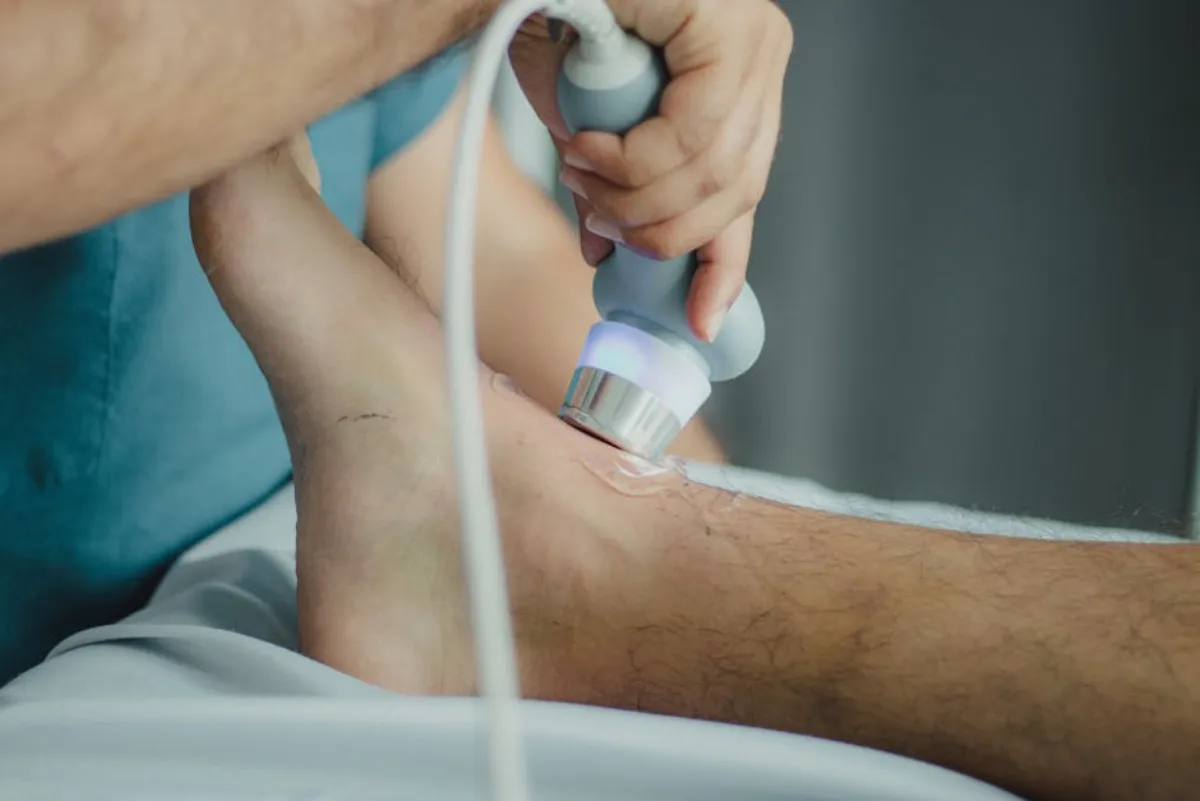
Treatment delivery: Coupling gel is applied to the shoulder, and the applicator is positioned over the calcific deposit. For focused ESWT, the depth of energy delivery is calibrated to match the depth of the deposit within the tendon. Treatment begins at lower energy and increases gradually.
The sensation during treatment is a deep, rhythmic thumping. Shoulder treatments tend to be more uncomfortable than extremity treatments because the calcific deposit is embedded within the rotator cuff at a depth that requires higher energy to reach effectively. Most patients describe the intensity as a 5-7 on a 10-point pain scale during active treatment. Protocols typically deliver 2,000 to 4,000 impulses per session.
After treatment: You may experience increased shoulder pain and soreness for 24 to 72 hours following the session. Some patients notice a temporary decrease in range of motion due to post-treatment swelling. Ice can be applied for comfort. Avoid overhead lifting and forceful shoulder movements for two to three days after each session.
Number of Sessions & Recovery Timeline
Standard protocols for calcific shoulder tendinitis:
Focused shockwave (fESWT): One to three sessions at high energy, spaced two to four weeks apart. This is the modality with the strongest evidence for calcium resorption and is preferred by many providers for this condition.
Radial shockwave (rESWT): Three to five sessions at moderate energy, spaced one week apart. While radial shockwave may be less effective at fragmenting dense, deep deposits compared to focused ESWT, it can still produce meaningful results, particularly for smaller or more superficial deposits.
Recovery timeline:
- Days 1-5 after each session: Moderate to significant shoulder soreness is common, especially after the first session. Some patients experience a “resorptive flare” — a temporary increase in pain as the fragmented calcium triggers an inflammatory and resorptive response. This is generally a positive sign.
- Weeks 2-4: Initial pain relief begins. Morning stiffness and night pain typically improve first. Range of motion may start to return.
- Weeks 4-8: Progressive improvement in function. Many patients can begin reaching overhead with less pain. The calcium deposit is actively being resorbed during this period.
- Weeks 8-12: Follow-up imaging (X-ray or ultrasound) is typically performed at this point to assess calcium resorption. Most patients show at least partial deposit dissolution.
- 3-6 months: Maximum improvement is usually reached. Studies show that calcium resorption can continue for up to six months after the final treatment session.
Important note on the resorptive flare: A temporary increase in shoulder pain two to four weeks after treatment — sometimes described as acute bursitis — can occur as the dissolving calcium irritates the surrounding bursa. While uncomfortable, this is typically a sign that the treatment is working. Your provider may recommend short-term use of ice and gentle range-of-motion exercises during this phase. Avoid anti-inflammatory medications if possible, as they may slow the resorptive process.
Physical therapy is an important complement to shockwave treatment. A shoulder-specific exercise program focusing on rotator cuff strengthening and scapular stabilization should be started once acute post-treatment soreness subsides.
Cost & Insurance Coverage
Shockwave therapy for calcific shoulder tendinitis typically costs $300 to $600 per session. A full course ranges from $300 to $3,000 depending on the number of sessions required, the type of shockwave used, and your geographic location.
Insurance coverage: ESWT for calcific shoulder tendinitis is off-label in the U.S., so insurance coverage is uncommon. However, the unusually strong evidence base for this indication — including multiple level-1 studies published in major orthopedic journals — gives providers a stronger foundation for insurance appeals compared to many other shockwave applications. If your provider is willing to submit a peer-to-peer review with your insurer, citing the Gerdesmeyer 2003 and Albert 2007 trials, approval is possible in some cases.
Cost comparison with alternatives:
- Ultrasound-guided needling (barbotage): $500-$1,500 per procedure, often requires sedation, and has a similar evidence base to ESWT
- Corticosteroid injection: $150-$400, provides temporary pain relief but does not dissolve the deposit and may weaken the tendon with repeated use
- Arthroscopic surgical removal: $5,000-$15,000 (before insurance), requires anesthesia, 2-4 weeks in a sling, and 3-6 months of rehabilitation
Given the non-invasive nature of ESWT, the strong evidence for calcium resorption, and the absence of surgical risks, shockwave therapy represents a compelling value proposition for many patients. For more pricing context, see our shockwave therapy cost guide.
Who Is a Good Candidate?
Shockwave therapy for calcific shoulder tendinitis is well-suited for a broad range of patients, from those who have just been diagnosed to those who have failed other non-surgical treatments. You may be a good candidate if:
- You have a confirmed calcific deposit in the rotator cuff on X-ray or ultrasound
- The deposit is causing pain, restricted range of motion, or functional limitations
- You have tried physical therapy and/or corticosteroid injections without lasting improvement
- You want to avoid surgery or are looking for a non-invasive first-line treatment
- Your deposit is in the formative or resting phase (dense, well-defined deposits tend to fragment well with shockwave)
Factors that influence outcomes:
- Deposit size: Larger deposits (greater than 1.5 cm) may require more sessions or higher energy but are still treatable
- Deposit density: Dense, well-defined deposits on X-ray (Gartner type I) tend to fragment more effectively than soft, cloudy deposits (type III), though type III deposits may be in the resorptive phase and closer to resolving on their own
- Duration of symptoms: Both recent and long-standing calcific tendinitis respond to shockwave therapy; there is no clear “too late” threshold in the literature
- Multiple deposits: Patients with more than one deposit can still be treated; each deposit is targeted individually
Contraindications — shockwave therapy should NOT be used if you have:
- A full-thickness rotator cuff tear (partial tears are not a contraindication, but the provider should be aware)
- A bleeding disorder or are taking anticoagulant medication
- An active infection at the treatment site
- A tumor or malignancy in the treatment area
- A pacemaker or other implanted cardiac device (some devices may be sensitive to shockwave energy; discuss with your cardiologist)
- Pregnancy
When to consider other options: If the deposit is in the acute resorptive phase — characterized by sudden, severe pain that came on rapidly — it may resolve on its own with supportive care (rest, ice, NSAIDs, or a corticosteroid injection for symptom relief). Shockwave therapy is most appropriate for chronic, stable deposits that are not spontaneously resolving.
If imaging has confirmed a calcific deposit in your shoulder and the pain is affecting your daily life, shockwave therapy is one of the most evidence-supported non-surgical options available.
Learn More
Explore our complete guide to shockwave therapy conditions or browse our latest research and articles to learn more about ESWT treatment options.
References
-
Gerdesmeyer L, Wagenpfeil S, Haake M, et al. Extracorporeal shock wave therapy for the treatment of chronic calcifying tendonitis of the rotator cuff: a randomized controlled trial. JAMA. 2003;290(19):2573-2580. PubMed
-
Albert JD, Meadeb J, Guggenbuhl P, et al. High-energy extracorporeal shock-wave therapy for calcifying tendinitis of the rotator cuff: a randomised trial. J Bone Joint Surg Br. 2007;89(3):335-341. PubMed
-
Hsu CJ, Wang DY, Tseng KF, Fong YC, Hsu HC, Jim YF. Extracorporeal shock wave therapy for calcifying tendinitis of the shoulder. J Shoulder Elbow Surg. 2008;17(1):55-59. PubMed
-
Ioppolo F, Tattoli M, Di Sante L, et al. Clinical improvement and resorption of calcifications in calcific tendinitis of the shoulder after shock wave therapy at 6 months’ follow-up: a systematic review and meta-analysis. Arch Phys Med Rehabil. 2013;94(9):1699-1706. PubMed
-
Louwerens JK, Sierevelt IN, van Noort A, van den Bekerom MP. Evidence for minimally invasive therapies in the management of chronic calcific tendinopathy of the rotator cuff: a systematic review and meta-analysis. J Shoulder Elbow Surg. 2014;23(8):1240-1249. PubMed
Frequently Asked Questions
Is shockwave therapy FDA-approved for calcific shoulder tendinitis?
ESWT for calcific shoulder tendinitis is used off-label in the United States. Despite lacking specific FDA clearance for this indication, it has the strongest evidence base of nearly any shockwave application. Multiple high-quality randomized controlled trials have demonstrated its ability to break down calcium deposits and relieve pain, and it is recommended in European and international clinical guidelines.
Does shockwave therapy actually dissolve calcium deposits in the shoulder?
Yes. Studies consistently show that shockwave therapy leads to partial or complete resorption of calcium deposits in a significant percentage of patients. In the Gerdesmeyer 2003 trial, complete or partial calcium resorption occurred in 85.8% of patients receiving high-energy ESWT at six months. The mechanical energy is thought to fragment the deposits and trigger a cellular resorption process.
How painful is shockwave therapy for calcific shoulder tendinitis?
Shoulder treatments tend to be more uncomfortable than other areas due to the depth of the calcific deposits and the sensitivity of the shoulder structures. Most patients describe it as a deep, thumping pain that is intense but brief. Providers typically start at lower energy and increase gradually. Some protocols use local anesthesia for focused high-energy treatments, though evidence suggests outcomes may be better without it.
How many sessions of shockwave therapy are needed for shoulder calcification?
Most protocols involve three to four sessions of radial shockwave spaced one week apart, or one to two sessions of focused high-energy shockwave spaced two to four weeks apart. The optimal number depends on the size and density of the calcium deposit and the type of shockwave device used.
What happens to the calcium after shockwave treatment?
After shockwave therapy fragments the calcium deposit, the body’s immune cells (primarily macrophages) absorb and remove the debris through a natural resorption process. This occurs gradually over weeks to months. During the resorption phase, some patients experience a temporary flare-up of pain as the dissolving calcium triggers a local inflammatory reaction. This is generally a positive sign that resorption is occurring.
Continue Learning
Explore our other in-depth condition guides and patient resources to understand your treatment options.