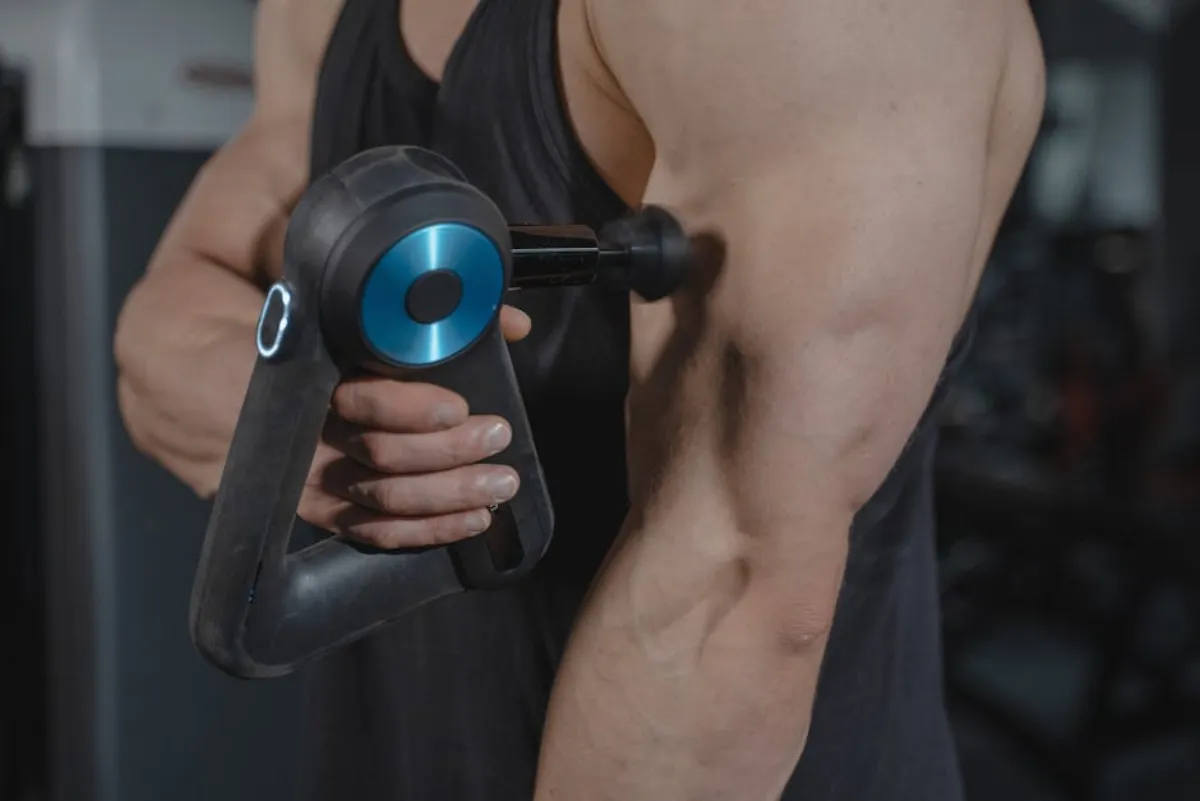
Your friend swears their $400 Theragun is “basically the same as shockwave therapy.” A device on Amazon is literally labeled “shockwave massage gun.” And you’re wondering whether clinical shockwave therapy – at $200-$500 per session – is really worth it when you could buy a percussion device and treat yourself at home.
The short answer: they are not the same thing. Not even close. But the comparison deserves a fair explanation, because massage guns are useful tools – they’re just useful for different reasons.
The Physics: Two Fundamentally Different Technologies
This is where the conversation should start, because the difference isn’t subtle.
Clinical shockwave therapy (ESWT) generates acoustic pressure waves – supersonic wavefronts that travel through tissue at speeds exceeding the speed of sound. These waves create rapid pressure changes at the cellular level, triggering biological signaling cascades (mechanotransduction) that stimulate healing responses. Clinical devices operate at 1-22 Hz with peak pressures measured in megapascals (MPa).
Percussion massage devices (Theragun, Hypervolt, TimTam, and similar products) use a motor-driven piston to deliver rapid mechanical strikes to the skin and underlying muscle. These strikes create local vibration and percussion at 30-60 Hz. The mechanism is essentially motorized massage – mechanical compression and release of superficial tissue.
The distinction matters because the therapeutic effects of ESWT depend on the unique physical properties of acoustic shockwaves – specifically their ability to create cavitation (microscopic gas bubble formation and collapse) and mechanotransduction (cellular conversion of mechanical signals into biological responses). Percussion devices don’t generate these phenomena.
Energy Output: Orders of Magnitude Apart
The energy gap between these technologies is not a matter of degree. It’s a matter of kind.
| Parameter | Clinical ESWT (Focused) | Clinical ESWT (Radial) | Massage Gun |
|---|---|---|---|
| Peak pressure | 10-100 MPa | 1-10 MPa | ~0.01-0.1 MPa |
| Frequency | 1-22 Hz | 1-22 Hz | 30-60 Hz |
| Depth of penetration | 4-12 cm | 1-4 cm | 1-2 cm (superficial) |
| Energy delivery | Acoustic pressure waves | Pneumatic pressure waves | Mechanical percussion |
| Cavitation effect | Yes | Minimal | No |
A clinical focused ESWT device delivers roughly 100 to 1,000 times more peak pressure than a massage gun. That’s not a marginal difference – it’s the difference between a garden hose and a fire hose.
Depth of Effect: Surface vs. Deep Tissue
Massage guns primarily affect superficial muscle tissue in the top 1-2 cm. They work well for reducing surface-level muscle tension, breaking up superficial knots, and providing pre- and post-workout comfort.
Clinical ESWT – especially focused shockwave – penetrates 4-12 cm into tissue, reaching deep tendons, ligaments, fascial structures, and bone. This deep penetration is essential for treating conditions like:
- Insertional Achilles tendinopathy (deep tendon attachment)
- Calcific shoulder tendinitis (calcium deposits within the rotator cuff)
- Greater trochanteric pain syndrome (deep hip structures)
- Trigger points in deep muscle layers
A massage gun simply cannot reach these structures with therapeutic energy. It’s like trying to dig a foundation with a garden rake – the tool wasn’t designed for the job.
What Massage Guns Actually Do Well
This isn’t about dismissing massage guns. They’re genuinely useful tools when used for what they actually do:
- Muscle soreness relief. Percussion reduces delayed-onset muscle soreness (DOMS) after exercise.
- Pre-workout activation. Brief percussion can increase blood flow and improve muscle readiness.
- Superficial myofascial release. Vibration and percussion can reduce superficial muscle tension and improve short-term flexibility.
- General relaxation. The rhythmic percussion provides comfort and stress relief.
- Accessibility. Self-administered, available anytime, no appointment needed.
These are real benefits. For someone managing general muscle tightness, post-workout soreness, or daily tension, a quality percussion device is a worthwhile investment.
The problem occurs when people expect their massage gun to do what clinical ESWT does – stimulate tissue regeneration, break down calcifications, promote neovascularization (growth of new blood vessels), or treat chronic tendinopathy. That’s asking a tool to do something it physically cannot do.
What Only Clinical ESWT Can Do
The biological effects unique to clinical shockwave therapy – and absent from percussion devices – include:
- Neovascularization. ESWT stimulates the growth of new blood vessels in chronically damaged tissue, improving oxygen and nutrient supply. This is a key mechanism for tendinopathy healing.
- Mechanotransduction-mediated repair. The acoustic energy triggers cells to initiate healing cascades, including growth factor release and stem cell recruitment.
- Calcium deposit breakdown. Focused ESWT can fragment calcium deposits in shoulder tendons, allowing reabsorption.
- Bone healing stimulation. ESWT promotes osteoblast activity in non-union fractures.
- Deep tissue collagen remodeling. The energy reaches depths and intensities sufficient to stimulate reorganization of fibrotic and degenerated tissue.
These effects have been documented in hundreds of published studies and are the basis for ESWT’s clinical applications.
The Marketing Problem
The confusion between these technologies is partly a marketing creation. Consumer device manufacturers use terms like “shockwave,” “deep tissue percussion therapy,” and “acoustic wave technology” to imply equivalence with clinical treatments. This misleading language exploits the lack of regulated terminology in consumer product labeling.
For a deeper dive into how consumer device claims stack up against clinical reality, read our assessment of at-home shockwave therapy devices.
If you’re trying to decide between buying a massage gun and pursuing clinical ESWT, the answer depends on your goal:
- General muscle recovery and comfort? A massage gun is a reasonable tool.
- Treating a diagnosed musculoskeletal condition (chronic tendinopathy, plantar fasciitis, calcific tendinitis)? Clinical ESWT from a qualified provider is the evidence-based approach.
A qualified provider can help you understand whether your condition warrants clinical treatment or whether self-care tools are sufficient.
The Bottom Line
Shockwave therapy and massage guns are fundamentally different technologies that serve different purposes. Massage guns deliver mechanical percussion to superficial muscle tissue for comfort and recovery. Clinical ESWT delivers acoustic pressure waves deep into tissue to trigger biological healing processes that percussion cannot replicate. Both have value – but one cannot substitute for the other. If you need treatment for a chronic musculoskeletal condition, a $400 massage gun is not equivalent to clinical shockwave therapy, no matter what the marketing says.
Explore our condition guides to learn about conditions where clinical-grade ESWT has strong evidence.
References
- Schmitz C, Császár NB, Milz S, et al. Efficacy and safety of extracorporeal shock wave therapy for orthopedic conditions: a systematic review on studies listed in the PEDro database. Br J Sports Med. 2015;49(9):590-595. PubMed
Medical Disclaimer: This content is for informational purposes only and does not constitute medical advice. Shockwave therapy outcomes vary by individual and condition. Consult a qualified healthcare provider to determine if shockwave therapy is appropriate for your situation.