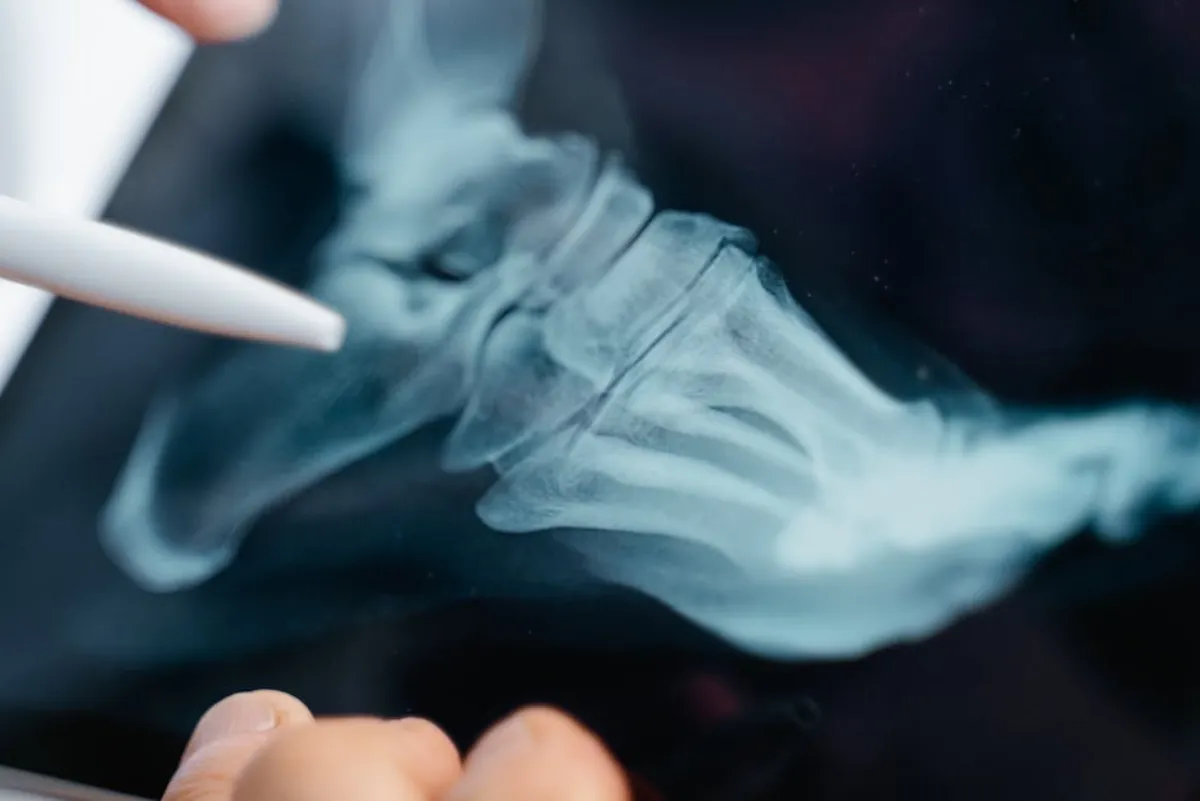
Your X-ray shows a bony projection jutting out from the bottom of your heel bone, and your first thought is: that sharp thing must be stabbing me from the inside. It makes intuitive sense. But the relationship between heel spurs and heel pain is far more complicated – and less direct – than most patients realize.
Understanding this distinction matters because it changes what treatment you actually need, and it explains why shockwave therapy for plantar fasciitis works differently than many people expect.
The Heel Spur Myth: Why the Bone Isn’t Usually the Problem
A heel spur (calcaneal spur) is a calcium deposit that forms on the underside of the heel bone, typically at the point where the plantar fascia attaches. On an X-ray, it looks like a small hook or shelf of bone. Patients and even some providers assume this bony growth is poking into the soft tissue of the foot and causing pain.
The evidence tells a different story. Studies have consistently shown that heel spurs are present in 10-20% of the general population, and the majority of people with visible spurs on imaging have no symptoms at all (Johal and Milner, 2012, Foot and Ankle International). Meanwhile, many patients with severe plantar fasciitis have no spur visible on X-ray.
This disconnect has led the orthopedic community to view most heel spurs as incidental findings – evidence that the plantar fascia has been under chronic mechanical stress, rather than the cause of the pain itself. The spur is a consequence, not a culprit.
What’s Actually Causing Your Heel Pain
In the vast majority of cases, heel pain attributed to a “spur” is actually caused by damage to the plantar fascia – the thick band of tissue that runs along the bottom of the foot and connects the heel bone to the toes.
When the plantar fascia is overloaded, micro-tears develop at its attachment point on the heel. In acute cases, this causes inflammation (plantar fasciitis). In chronic cases, the tissue degenerates – the collagen breaks down and the body’s normal repair process stalls. This condition is sometimes more accurately called plantar fasciosis to reflect the degenerative nature rather than an inflammatory one.
The spur forms over time as the body lays down calcium at the stressed attachment point. Think of it as the body’s attempt to reinforce a weak link in the chain. But the spur itself, once formed, is usually not pressing on nerves or piercing tissue. The pain comes from the damaged fascia surrounding it.
How ESWT Treats the Soft Tissue – Not the Spur
This distinction is crucial for understanding how shockwave therapy works and what it costs relative to other options.
Extracorporeal shockwave therapy (ESWT) delivers focused acoustic pressure waves to the damaged plantar fascia attachment. These waves stimulate several biological responses:
- Neovascularization – the formation of new blood vessels, improving blood supply to tissue that has lost adequate circulation
- Cellular signaling – triggering growth factor release and stem cell recruitment to the damaged area
- Pain modulation – affecting nerve fibers that transmit pain signals from the chronically irritated tissue
ESWT does not break apart or dissolve bony heel spurs. This is a common point of confusion, partly because of a related but different procedure: lithotripsy, which uses similar shockwave technology to break up kidney stones and certain calcific deposits. While lithotripsy is designed to fragment hard deposits, the ESWT protocols used for heel pain operate at different energy levels and target soft tissue healing.
Some studies have observed that calcifications near the fascia attachment may decrease in size over time after ESWT, but this is considered a secondary effect of improved tissue health – not the primary mechanism of pain relief.
When a Heel Spur Actually Is the Problem
There are uncommon situations where a heel spur does become clinically significant:
- Large inferior spurs that alter the weight-bearing surface of the heel and create focal pressure points
- Spurs that form on the back of the heel (posterior calcaneal spurs) associated with insertional Achilles tendinopathy (a different condition from plantar fasciitis)
- Acute fracture of the spur itself – rare, but can cause sudden sharp pain distinct from typical fascia pain
In these cases, the treatment approach may differ. Your provider can usually distinguish between spur-related and fascia-related pain through physical examination, imaging characteristics, and the specific location and pattern of your symptoms.
Lithotripsy vs. ESWT: Different Tools for Different Problems
Patients sometimes confuse extracorporeal shockwave therapy with extracorporeal shockwave lithotripsy (ESWL), which is used to break kidney stones. While both use acoustic shockwaves, the applications differ significantly:
| Feature | ESWT for Heel Pain | Lithotripsy for Kidney Stones |
|---|---|---|
| Target | Soft tissue (fascia/tendon) | Hard deposit (calcium/stone) |
| Goal | Stimulate healing | Fragment the deposit |
| Energy level | Low to medium | High |
| Sessions | 3-5 over several weeks | Often 1 session |
| Mechanism | Biological repair response | Mechanical fragmentation |
For calcific shoulder tendinitis, ESWT can sometimes help break down calcium deposits in the rotator cuff tendons – but this is a different condition from a bony heel spur, and the deposits are within soft tissue rather than on bone. Read our guide to calcific shoulder tendinitis to learn more about this distinct application.
Getting the Right Diagnosis First
If you’ve been told you have a heel spur and are exploring treatment options, the most important step is confirming what’s actually causing your pain. Ask your provider:
- Is my pain consistent with plantar fascia damage, or could the spur itself be contributing?
- Would an ultrasound or MRI help clarify the soft tissue condition?
- Have other diagnoses been ruled out (stress fracture, nerve entrapment, fat pad atrophy)?
If the diagnosis is plantar fasciitis or plantar fasciosis – which it is in the vast majority of “heel spur” cases – then treatment should focus on the soft tissue, not the bone. That’s where ESWT fits in.
The Bottom Line
Most heel spurs are bystanders, not culprits. The pain you’re feeling almost certainly comes from the damaged plantar fascia, not the bony projection on your X-ray. Shockwave therapy treats the soft tissue problem – stimulating repair in the degenerated fascia – rather than breaking apart the spur itself. If you’ve been living with chronic heel pain and want to explore ESWT, start by confirming the right diagnosis with a qualified provider.
Read our guide to plantar fasciitis to learn more about ESWT for heel pain.
References
- Johal KS, Milner SA. Plantar fasciitis and the calcaneal spur: fact or fiction? Foot Ankle Surg. 2012;18(1):39-41. PubMed